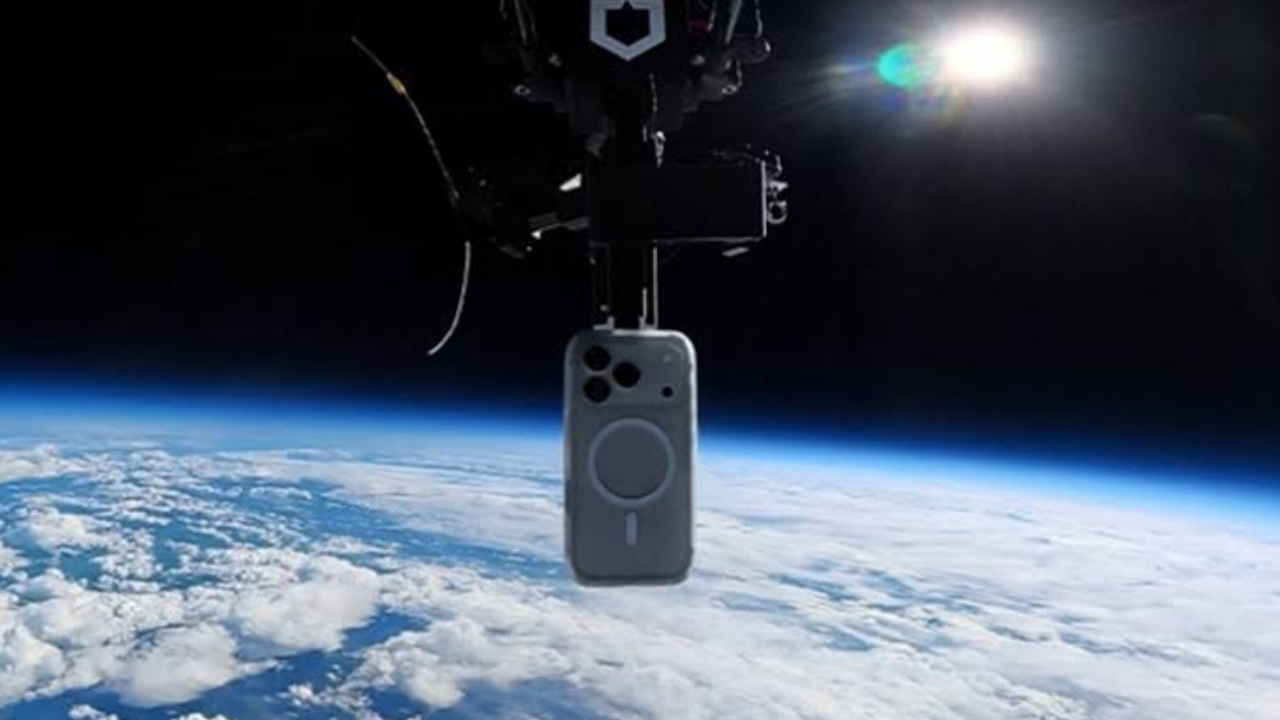
An iPhone 17 Pro has survived an extraordinary fall from 30,607 meters above the ground in northern Sweden. The phone was released from a high-altitude balloon and fell for about 25 minutes before landing in a remote area.
The test was carried out by RHINOSHIELD with aerospace company Sent Into Space. The phone was protected by a special AirX case, and the attempt was recognized by Guinness World Records for the highest drop of a mobile phone in a protective case onto natural terrain.
The iPhone was dropped from more than 30 kilometers up
The experiment took place on June 24, 2026, near the Esrange Space Center in Kiruna, Sweden. A balloon carried the iPhone 17 Pro to an altitude of 30,607 meters, which is more than 30 kilometers above the ground.
At that height, the phone was already well inside the stratosphere. It was also far above the normal cruising altitude of passenger aircraft.
Once the phone reached the target height, it was released and allowed to fall without a parachute. The complete descent took roughly 25 minutes.

The phone faced extreme cold during the fall
The drop was not simply a test of how well the iPhone could handle a hard landing. The device also had to survive the conditions found high above the Earth.
Temperatures during the test fell to around minus 60 degrees Celsius. Atmospheric pressure at that altitude was also only about 1 percent of the pressure found at sea level.
These conditions are very different from anything a normal smartphone experiences during everyday use. The phone then had to survive the final impact after its long descent.
The protective case played the key role
The iPhone was not simply thrown into the sky with no protection at all. It was fitted with RHINOSHIELD’s AirX case, which was the main protection allowed during the test.
The case was designed to spread and absorb impact energy when the phone hit the ground. Its design uses cushioning structures intended to reduce the force reaching the phone.

The company had tested the case before the stratospheric attempt, including cold-temperature tests, pressure tests and separate drop tests. The reported testing also included a drop from about 23 meters before the much larger real-world challenge.
What happened when the iPhone reached the ground?
Finding the phone was another challenge. The device landed in an uninhabited area, and the recovery team used tracking equipment to narrow down its location.
The search reportedly lasted more than five hours before the phone was found. Despite the huge fall, the device was recovered in working condition.
According to the reported Guinness inspection, the iPhone 17 Pro could still be switched on, its touchscreen worked, its cameras remained usable and a phone call could be made. The device also showed no visible damage of the kind expected from such an extreme impact.
Key details from the record-setting test
| Test detail | Result |
|---|---|
| Phone used | iPhone 17 Pro |
| Drop height | 30,607 meters |
| Location | Kiruna, Sweden |
| Flight method | High-altitude balloon |
| Free-fall time | About 25 minutes |
| Parachute | No |
| Protective equipment | RHINOSHIELD AirX case |
| Lowest reported temperature | About minus 60 degrees Celsius |
| Recovery time | More than five hours |
| Condition after recovery | Phone remained functional |
| Record | Highest drop of a mobile phone in a protective case onto natural terrain |
The Guinness World Records recognition was issued on August 26, 2026, according to reports on the event.
This does not mean an iPhone can normally survive any fall
The experiment is impressive, but it is important to understand what the test actually proves.
The iPhone 17 Pro was fitted with a specially designed protective case, and the test was organized under controlled conditions. The phone was not simply dropped from an airplane with no preparation.
The result mainly demonstrates the ability of the phone-and-case combination to survive an extreme impact. It should not be taken as proof that an iPhone 17 Pro without a case can survive a similar fall.
There is also a major difference between the height of a fall and the speed at which an object hits the ground. Air resistance affects a falling object, so a phone does not continue accelerating indefinitely throughout a very long fall.
Why the test is unusual
A smartphone normally has to deal with much smaller dangers, such as being dropped from a table, slipping out of a pocket or falling down stairs. A 30,607-meter drop is on an entirely different scale.

The test combined several difficult conditions in one experiment:
- The phone was taken to more than 30 kilometers above the ground.
- It experienced extremely low temperatures and very low air pressure.
- It fell for about 25 minutes without a parachute.
- It eventually landed on natural terrain and was recovered in working condition.
A dramatic durability test with a practical lesson
The iPhone 17 Pro’s survival after the 30,607-meter fall is certainly unusual, but the biggest takeaway is the role played by impact protection. The phone was surrounded by a case specifically designed to absorb and spread impact forces.
The experiment also shows how extreme smartphone durability tests have become. Instead of testing devices only with ordinary drops, companies are now using unusual environments to demonstrate how their accessories perform under conditions far beyond normal use.
For everyday users, there is no reason to expect a phone to survive anything close to this kind of fall. But after spending about 25 minutes falling from the stratosphere, landing in remote Swedish terrain and still being able to make a call and take pictures, this particular iPhone 17 Pro has certainly had a fall that will be difficult to beat.