
 Join WhatsApp
Garlic may look quiet above the soil, but a lot is happening underground before the bulbs are ready to come out. While the green leaves grow above the ground, the planted clove slowly turns into a new bulb with several cloves packed inside.
The final weeks are especially important because the underground cloves are filling out, developing their shape and building the dry outer covering that helps protect the garlic after harvest.
It starts with a single planted clove
A garlic bulb does not suddenly appear underground. The process begins when an individual garlic clove is planted in the soil. After planting, the clove develops roots and sends up green leaves.
During the early part of growth, much of the plant’s energy goes into making roots and leaves. These leaves are important because they collect sunlight and help the plant make food. That food is later used to build the bulb underground.
As the plant continues to grow, the original clove changes from being the planting material into a new garlic plant. New growing points develop around the central part of the plant, and these eventually become the individual cloves inside the mature bulb.
The underground bulb slowly starts taking shape
The most interesting part happens when the plant moves from mainly growing leaves to developing its bulb. The individual cloves begin forming and expanding around the central stem.
At first, the developing cloves are small and not clearly separated. As the bulb grows, they become larger and take on the familiar wedge-like shape seen in mature garlic.
The outer layers around the bulb also become important. These dry, paper-like layers protect the cloves and help keep the finished bulb together.
Temperature and day length play an important role in this change. Garlic varieties respond differently to growing conditions, which is one reason different types of garlic can mature at different times.
What is happening to the leaves above the soil?
While the bulb is growing underground, the leaves above the ground are still doing their job. They collect sunlight and help supply food to the developing bulb.
As maturity gets closer, the plant gradually stops putting as much energy into producing fresh green leaves. The older leaves begin turning yellow and then brown.
This change is useful to growers because the condition of the leaves can give an idea of what is happening underground. However, the exact timing varies with the garlic variety and growing conditions.
A garlic plant with some lower leaves turning brown does not automatically mean every bulb is ready. The best way to check is to carefully dig up a test plant and look at the bulb itself.
Hardneck garlic has another clue
Some garlic varieties, especially hardneck types, produce a flower stalk called a scape. It grows up from the middle of the plant and can curl as it develops.
The scape is not the garlic bulb itself. It is part of the plant’s flowering structure. Many growers remove it while it is young so more of the plant’s resources can go toward bulb development.
Softneck garlic generally does not produce the same type of scape.
This difference is useful because not all garlic plants behave in exactly the same way. The variety needs to be considered when deciding when to harvest.
The final underground changes before harvest
As the garlic gets closer to maturity, the cloves continue to fill out inside the bulb. They become more clearly separated and develop a firm, wedge-like shape.
The wrapper around the bulb also changes. Some of the outer layers naturally begin to dry and break down, while enough inner layers remain to protect the cloves.
A mature bulb should feel firm and the cloves should fit tightly inside their protective covering. If the cloves are still poorly developed or the bulb feels loose, it may need more time.
Growers can check a few average plants rather than pulling up the entire crop. A bulb can be carefully dug from the soil and inspected before deciding whether the rest of the crop is ready.
How to tell when the garlic is ready
There is no single calendar date that works for every garlic crop. Variety, planting time, weather and growing conditions can all affect maturity.
The leaves are one of the easiest signs to watch. When several of the lower leaves have turned yellow or brown while a number of upper leaves remain green, the crop may be approaching harvest.
A closer check gives more information. When a test bulb is dug up, the cloves should be properly formed and filled out. They should also be covered by firm wrapper layers.
Some useful signs to look for are:
- Lower leaves have started turning yellow or brown while several upper leaves are still green.
- The bulb has developed clearly separated cloves.
- The cloves have become full and wedge-shaped rather than small and round.
- The outer wrapper is still protecting the bulb instead of being badly broken down.
Harvesting too early can mean smaller bulbs that have not fully developed. Waiting too long can also create problems because the protective wrapper can break down and the cloves may begin separating from the bulb.
Why the timing matters after the bulb is formed
Garlic is not finished simply because the underground bulb has reached a useful size. The outer covering also needs to remain in good condition.
If garlic is harvested too early, the cloves may not have developed fully and the bulb may not store as well. If it stays underground for too long, the outer wrapper can become too thin or break apart, leaving the cloves exposed.
For this reason, growers often watch the leaves and then check a few bulbs underground before harvesting the whole crop.
As harvest approaches, watering is commonly reduced or stopped according to the growing conditions and production method. Excess moisture close to harvest can make drying and storage more difficult.
What happens immediately after harvest?
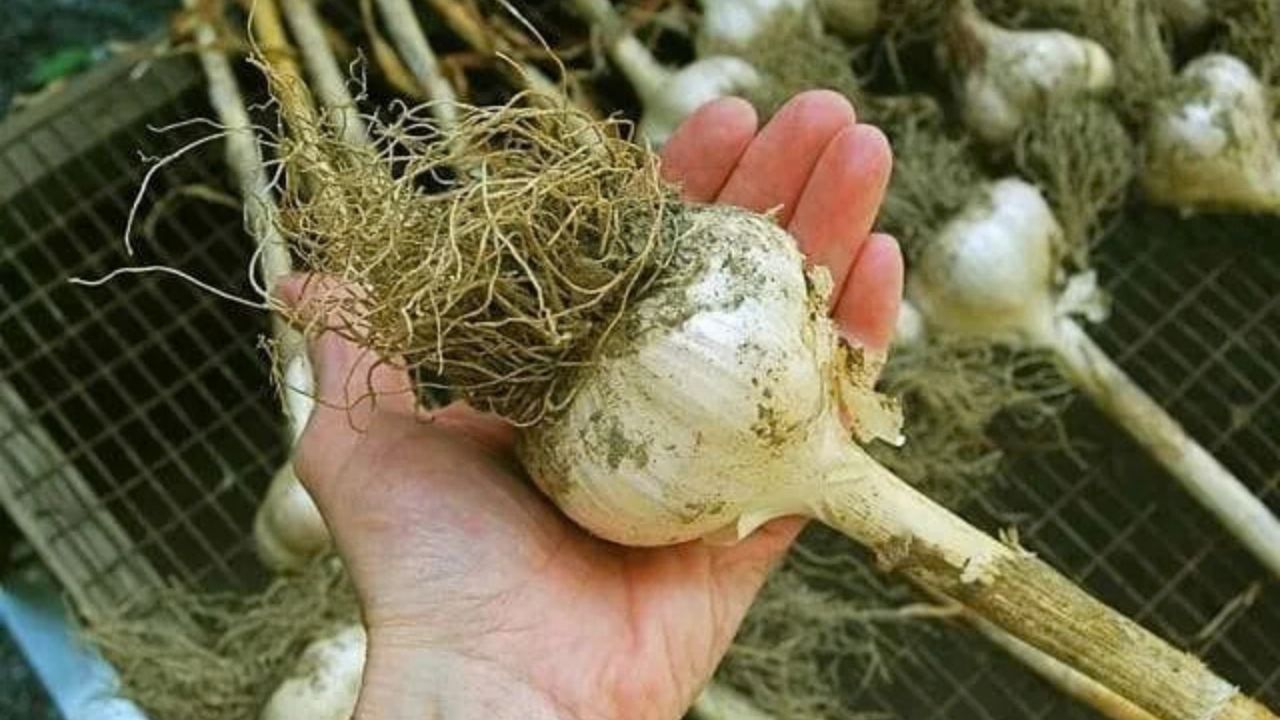
Freshly dug garlic contains more moisture than the garlic normally seen in a kitchen. The bulbs therefore need to be dried, or cured, before long-term storage.
The plants are carefully lifted from the soil rather than being pulled roughly by the leaves. The bulbs are then kept in a dry, shaded or protected place with good air movement so the outer layers and neck can dry.
Curing allows the outer covering to become dry and firm. Once properly cured, the garlic can be cleaned and prepared for storage.
The important point is that the underground work and the drying process are connected. A well-developed bulb needs to be harvested at the right stage and then handled carefully so it remains in good condition.
The hidden process explains the final garlic bulb
What looks like a simple garlic bulb is actually the result of several stages of growth. A single planted clove first produces roots and leaves. Later, new cloves begin forming underground and gradually fill out around the central part of the plant.
Near maturity, the plant’s leaves begin to die back, the cloves become clearly shaped and the protective outer layers become dry. Once these signs come together, the garlic is ready to be carefully checked and harvested.
So, before a garlic bulb reaches the kitchen, most of its important development has already happened beneath the soil. The green leaves above ground are essentially supporting a much bigger process below, where the small planted clove slowly turns into the full head of garlic that is finally lifted at harvest time.