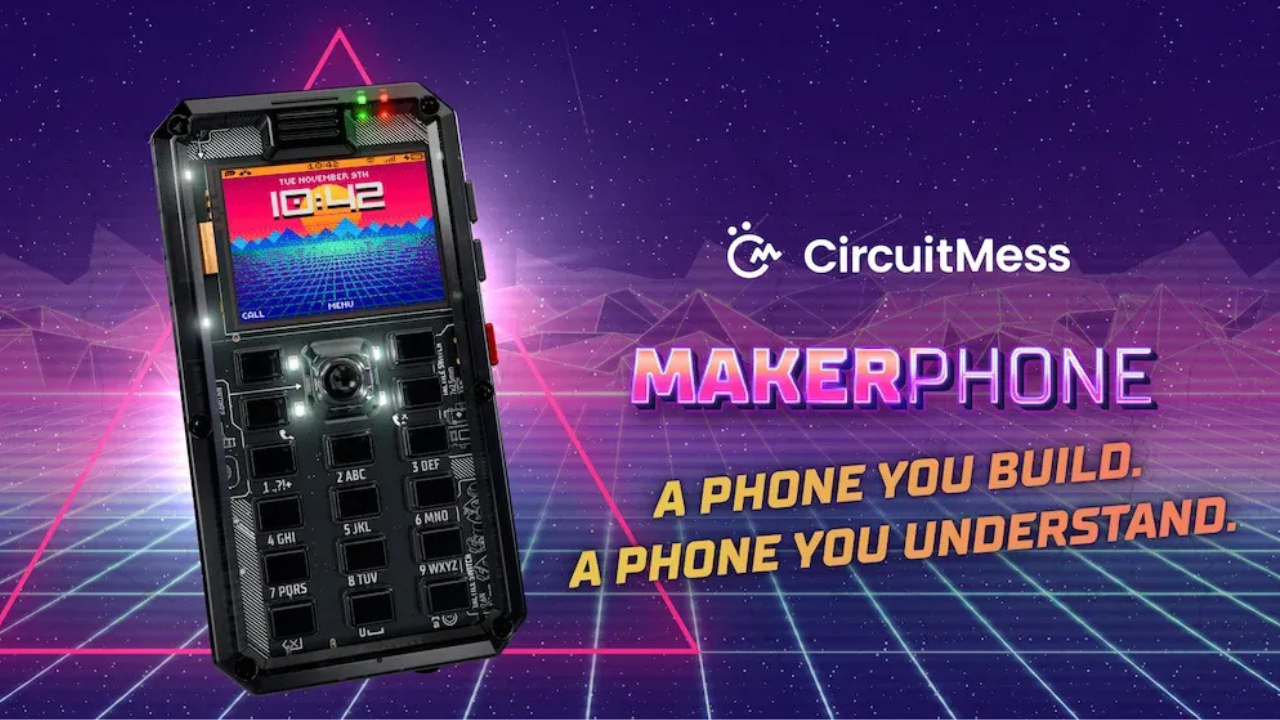
What if you could build your own phone instead of simply taking one out of a box? MAKERphone 2.0 is designed around exactly that idea. It is a working 4G LTE phone that users assemble themselves, then program and customize with their own software.
The new device comes from CircuitMess, the company behind the original MAKERphone. Unlike the first model, the new version does not require soldering and adds 4G, Wi-Fi, Bluetooth, a modular expansion port and support for programming in MicroPython and C++.
This Is a Real 4G Phone, Not Just a Learning Kit
MAKERphone 2.0 is built as an educational device, but it can also work as a normal mobile phone for calls and text messages. It uses 4G LTE Cat-1 with 2G fallback and takes a standard nano-SIM.
Users can therefore put their own SIM card into the phone and connect to a supported cellular network. A SIM is needed for regular calls and texts, while many other functions can still work over Wi-Fi without one.
The phone is intentionally much simpler than a modern smartphone. There is no touchscreen, web browser, app store or social media. Instead, it focuses on calls, messages, games, music and the ability to create your own software.
You Actually Build the Phone Yourself
One of the biggest changes from the original MAKERphone is the assembly process.
The first MAKERphone required about seven hours of soldering. MAKERphone 2.0 is designed so that the parts click, screw or plug together, with no soldering required. CircuitMess says the build takes about two hours when following its illustrated instructions and video guides.

That makes the device much more approachable for people who want to learn how electronics work without already knowing how to solder.
The finished phone measures 11.5 by 6 by 1.8 centimeters and weighs 104 grams. It has a 1.77-inch color screen with a resolution of 160 by 128 pixels, a 12-key number pad and a navigation joystick.
| Feature | MAKERphone 2.0 |
|---|---|
| Cellular network | 4G LTE Cat-1 with 2G fallback |
| SIM | Nano-SIM |
| Screen | 1.77-inch color display |
| Resolution | 160 × 128 pixels |
| Controls | 12-key keypad and navigation joystick |
| Wi-Fi | Yes |
| Bluetooth | Yes |
| Storage | MicroSD |
| Charging | USB-C |
| Headphone jack | Yes |
| Battery | 1,000 mAh |
| Weight | 104 grams |
You Can Write Your Own Apps
The phone’s biggest difference from a normal feature phone is what happens after you finish building it.
MAKERphone 2.0 can be programmed using MicroPython or C++ with Arduino. Users can create their own apps, games, menus and interfaces rather than depending on an app store.
The phone is built around an ESP32-S3 processor with 4MB of flash storage and 4MB of PSRAM for firmware and apps. Photos, music and other files can be stored on a microSD card.
That setup makes the phone more like a small electronics project than a locked-down consumer smartphone.
For someone learning to code, the idea is simple: write something, send it to the phone and see it work on hardware you assembled yourself.

AI Can Help You Start Coding
CircuitMess has also added an optional AI-assisted coding tool called VibeBoy.
Instead of starting with programming syntax, users can describe what they want in plain English. VibeBoy can then create code based on the description. Users can read the code, change it and send the finished project to the phone.
The AI tool is not required. Users who already know how to program can work directly with MicroPython or C++ instead.
Each MAKERphone 2.0 includes three months of unlimited VibeBoy AI usage, followed by a free tier. CircuitMess says its Pro option costs $4.99 per month after the included period.
Modular Hardware Makes the Phone More Interesting
MAKERphone 2.0 also has a dedicated expansion port. Optional modules can add new hardware features without requiring users to redesign the entire phone.
The available modules include:
- Camera for taking photos
- Large speaker for louder audio
- Flashlight with a bright LED array
- Environment module for measuring temperature and humidity
There are also infrared and DIY perf-board modules. The perf board is aimed at users who want to build their own circuits. Only one module can be connected at a time because the phone has a single expansion port.

When a supported module is connected, its related app can appear in the phone’s menu automatically. This makes the expansion system easier to use than building every extra feature from scratch.
The Phone Is Designed to Stay Simple
MAKERphone 2.0 deliberately avoids many features found on modern smartphones.
There is no web browser, no app store and no social media. The company says this is intentional. The idea is to create a device where users make the software they want instead of downloading hundreds of ready-made apps.
The phone does include useful everyday features such as a music player, photo gallery, calendar, alarms, notes and more than 10 built-in retro games. It also has Wi-Fi, Bluetooth, USB-C and a headphone jack.
The result is a device that sits somewhere between a basic mobile phone and a programmable electronics kit.
A Big Change From the Original MAKERphone
The original MAKERphone launched as an educational DIY phone in 2018. Its second-generation model keeps the same basic idea but changes much of the hardware.
| Feature | Original MAKERphone | MAKERphone 2.0 |
|---|---|---|
| Network | 2G | 4G LTE |
| Assembly | Required soldering | No soldering |
| Expansion port | No dedicated port | Dedicated modular port |
| Connectivity | More limited | 4G, Wi-Fi and Bluetooth |
| Programming | DIY programming | MicroPython and C++ |
| Storage expansion | More limited | MicroSD |
| Charging | Earlier design | USB-C |
CircuitMess says the new model was developed after feedback from more than 6,000 original MAKERphone users.

How Much Does MAKERphone 2.0 Cost?
The MAKERphone 2.0 is being offered through a Kickstarter campaign. The company’s campaign information currently lists backing prices starting at $109, while the stated regular retail price is $169. Prices can vary by campaign tier and availability.
The campaign also lists an estimated delivery of August 2027. CircuitMess makes clear that this is an estimate rather than a guaranteed delivery date.
The base kit does not include every expansion module. Those modules are available separately or through higher campaign tiers.
Who Is MAKERphone 2.0 Really For?
This phone is not trying to replace an iPhone or a high-end Android phone. It does not have the screen, app selection or online services that people expect from a modern smartphone.
Its appeal is somewhere else.
It is aimed at people who want to understand how their technology works, especially students, parents, hobbyists and people who enjoy building electronics projects. It can also be useful for someone who wants a basic phone without social media and other smartphone distractions.
The fact that it is programmable gives the device another purpose. Instead of simply using the phone, the owner can change what the phone does.

The Bottom Line
MAKERphone 2.0 takes an unusual approach to the modern phone. It is a real 4G LTE mobile phone, but the main attraction is not its cellular hardware. The real idea is that you build it yourself and then have the freedom to create your own software and hardware features.
The second-generation model removes the need for soldering, adds 4G connectivity, supports Wi-Fi and Bluetooth, and provides a modular expansion port. It also supports MicroPython and C++, while the optional VibeBoy tool gives beginners an easier way to start coding.
For anyone looking for a powerful smartphone, MAKERphone 2.0 is clearly not the answer. But for someone who wants to learn electronics, experiment with code and understand how a phone works from the inside out, it offers something most commercial phones simply do not: the chance to build the device and decide what it can do.