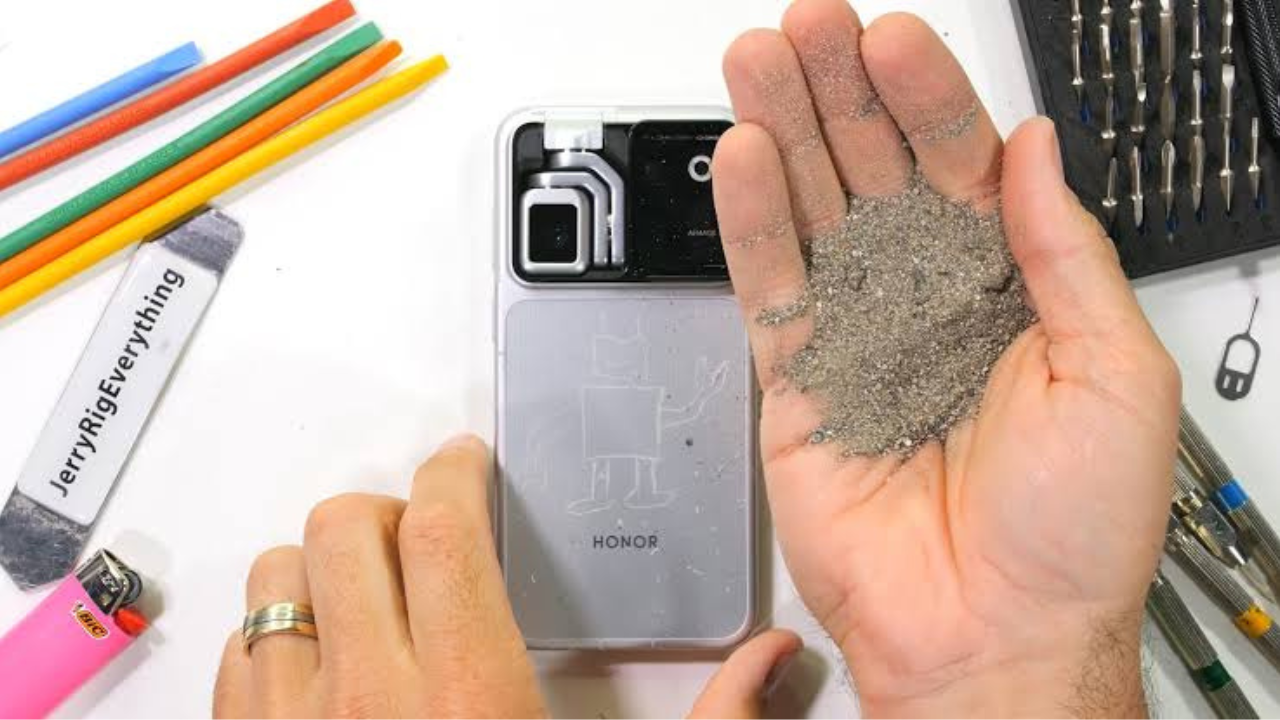
The Honor Robot Phone stands out from almost every other smartphone because its main camera can physically move. A built-in motorized gimbal lifts the camera out of the phone and moves it to help stabilize video and track subjects.
That unusual design also creates a new durability question. A recent durability test found that the camera mechanism can become very hot when it is forced to work under stress, while dust and sand appear to be a bigger concern for the moving camera system.
The Robot Phone Has a Very Different Camera Design
The Honor Robot Phone is not a normal smartphone with a fixed camera module. Its main camera sits on a mechanical arm that can move while recording.
Honor says the system uses more than 100 precision parts and more than 100 patents. The company also says the titanium gimbal system was designed to be much smaller than traditional gimbals while improving its structural strength.
The moving camera is designed to help with video stabilization, subject tracking and camera movement. It can also give the phone some of the abilities normally associated with a small handheld gimbal camera.
That is the main reason the phone is so unusual. But having moving parts exposed to the outside world also creates problems that ordinary smartphones do not have.
Durability Testing Raises Questions About the Camera
A recent durability test by Zack Nelson examined how the Robot Phone behaves when the mechanical camera is put under pressure. The test found that the gimbal can tolerate some resistance while moving, but the mechanism can become very hot when its movement is blocked.
Reports from the test put the temperature of the robotic camera arm at around 50 degrees Celsius, or about 125 degrees Fahrenheit, under heavy stress.

That is a notable result, but it does not mean the camera normally reaches that temperature during everyday photography. The extreme heat was observed while the mechanism was being tested under unusual conditions.
The finding is mainly important because it shows how much heat the tiny motor and camera system can produce when they are forced to work against resistance.
Why Does the Camera Get So Hot?
The camera arm is packed into a small space, and its motor has to move a camera assembly that is physically separated from much of the phone’s main body.
In a traditional smartphone, important components can be positioned close to the phone’s internal cooling system. The Robot Phone has a different challenge because its main camera moves away from the main body when it is operating.
Honor says the phone has a custom cooling system designed to handle heat during extended recording. The company also says the phone uses a 7,060mAh silicon-carbon battery and supports 120W wired charging.
However, the durability test shows that the moving camera can still become very hot when its motor is placed under unusual stress.
Dust May Be a Bigger Problem Than Heat
Heat was one part of the durability test, but dust and sand are arguably more worrying because the camera has moving mechanical parts.
The camera arm has to move in and out of the phone. Sand or other small particles getting into the mechanism could interfere with that movement.

The reported durability testing found that dirt entering the mechanism could prevent the camera arm from fully retracting. This is particularly important because the Robot Phone’s main selling point depends on that mechanical system working correctly.
A normal fixed camera does not have this particular problem.
The Phone Does Not Have a Clearly Confirmed Official Dust Rating
There is some confusion around the Robot Phone’s protection rating.
Honor’s official launch information does not give the phone a clear IP dust and water rating. Some independent specifications list the phone as IP54, and some hands-on reports have also described it as having IP54 protection when the camera is closed. Other reports have noted that Honor itself has not clearly published an IP rating for the device.
This distinction is important because an IP rating is normally used to describe a product’s tested protection against things such as dust and water.
| Protection detail | What is known |
|---|---|
| Official Honor IP rating | Not clearly stated in the official launch information |
| IP54 | Listed by some independent specifications and reports |
| Dust concern | Important because of the moving gimbal mechanism |
| Camera extended | Protection can be different from when the mechanism is closed |
| Water exposure | The phone should not be treated like a fully waterproof device |
Some reports say the phone has IP54 protection when the gimbal is stowed, but Honor has also warned that the same level of protection should not be expected while the camera is deployed.
Why the Moving Camera Needs Extra Care
The Robot Phone’s camera is protected by a sliding cover when it is not being used. The cover helps shield the mechanism, but it cannot eliminate the risks created by moving parts.
When the gimbal is extended, parts of the mechanism are exposed. That makes the phone less suited to environments where there is a lot of sand, dust or other small debris.

This is especially worth remembering for outdoor filming. A phone that works perfectly in a clean room may face a very different situation on a beach, construction site or dusty road.
The durability test therefore highlights a simple trade-off: the mechanical camera gives the phone abilities that ordinary smartphones do not have, but it also creates another part that needs protection.
Honor Says the Gimbal Was Built for Everyday Use
Honor has said the gimbal mechanism went through reliability testing for repeated movement. The company has not, however, published a specific cycle-life number comparable to the figures sometimes given for mechanical smartphone parts.
Honor has also included software protection designed to detect abnormal resistance and help protect the gimbal from improper handling.
That means the company clearly considered the risks created by the moving mechanism. But there is still a difference between a manufacturer’s internal reliability testing and knowing exactly how a mechanism will behave after years of real-world use.
The Robot Phone Is Still Impressive
The durability concerns do not change the fact that the camera system is technically unusual.
The Robot Phone combines a smartphone with a motorized gimbal. The camera can move to help stabilize video and track subjects, allowing the phone to perform tasks that normally require a separate camera stabilizer.
The phone also includes a 6.31-inch LTPO OLED display, a Snapdragon 8 Elite Gen 5 processor and a 7,060mAh battery. Honor has partnered with ARRI on imaging features aimed at people who want more advanced video tools.

The unusual design is therefore not just a visual trick. The moving camera has a real purpose.
The Durability Trade-Off Is Clear
The Honor Robot Phone shows why unusual hardware can come with unusual risks.
A traditional smartphone has very few external moving parts. Its cameras, screen and other major components stay in fixed positions. The Robot Phone adds motors, a moving arm and a sliding cover to make its camera more capable.
That creates several things users need to consider:
- The gimbal can become very hot when its movement is heavily resisted.
- Dust and sand can be a serious concern for the moving mechanism.
- The camera’s protection when extended is more limited than when it is stored.
- Honor has not clearly published an official IP rating in its launch information.
For people who mainly use their phones indoors or in clean environments, these concerns may not be a major issue. For people who regularly film outdoors, especially around sand and dust, they deserve more attention.
Should You Be Worried About the Camera?
The durability test does not show that the Robot Phone’s camera will fail during normal use. The heat result came from a stress test, not ordinary photography.
The more practical concern is dirt getting into the moving mechanism. Because the camera has to physically move, dust and sand can potentially cause problems that would not affect a conventional fixed camera.
Honor’s own design includes a cover for the gimbal, and the company says the mechanism has undergone reliability testing. Still, users should avoid deliberately exposing the moving camera to dirt, sand or unnecessary physical force.

The Bottom Line
The Honor Robot Phone is one of the most unusual smartphones released this year, but its moving camera also makes durability more complicated.
Testing has shown that the gimbal can become very hot when its movement is blocked, reaching around 50 degrees Celsius under stress. More importantly, dust and sand appear to be a real concern because particles can interfere with the moving camera mechanism.
The phone’s water and dust protection also needs to be understood carefully. While some independent specifications list an IP54 rating when the camera is closed, Honor’s official launch material does not clearly provide an IP rating. Protection can also be different when the gimbal is extended.
The Robot Phone remains an impressive piece of engineering, but its unique camera comes with a simple rule for owners: treat the moving mechanism more carefully than you would a normal fixed smartphone camera.