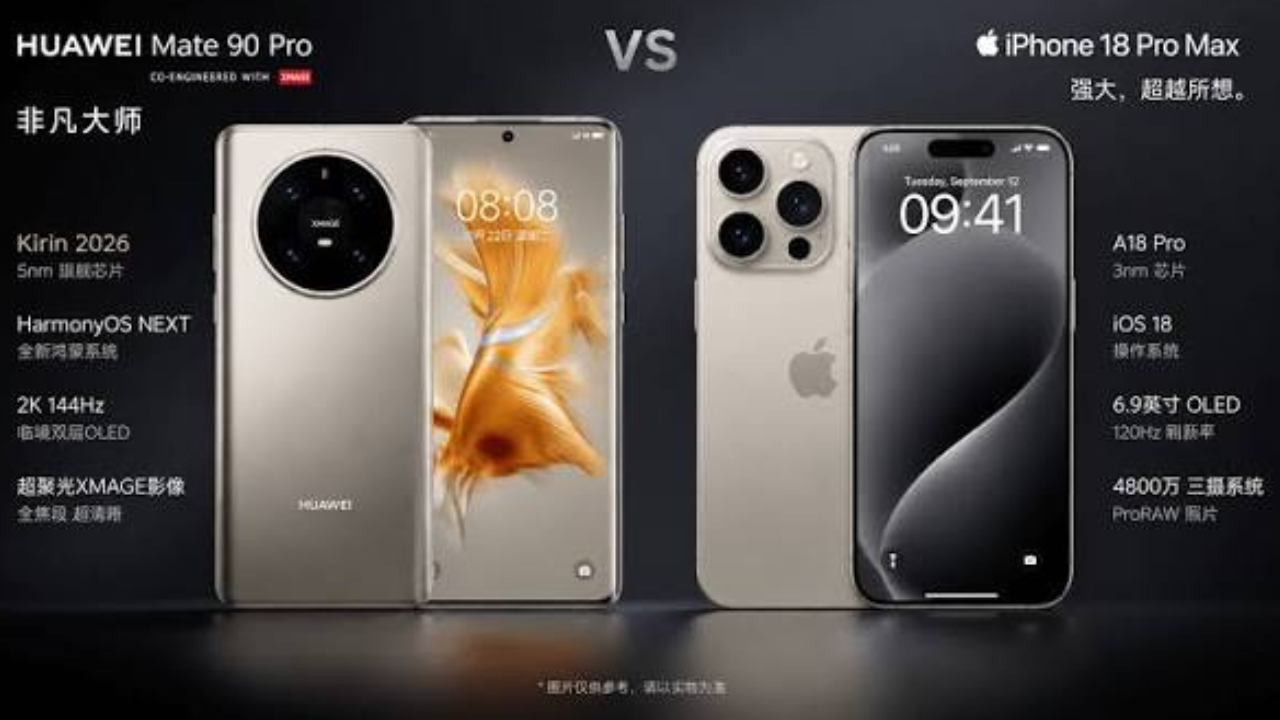
Huawei’s upcoming Mate 90 series could mark an important change for the company’s smartphones in China. New regulatory listings suggest that at least two upcoming Huawei phones are officially being described as 5G devices, raising the possibility that 5G connectivity is returning to the company’s China-market flagship phones.
The development is especially notable because Huawei’s recent flagship phones in China spent years without officially advertised 5G connectivity after US restrictions affected the company’s access to advanced chip technology. The latest Mate 90 information also points to a new generation of Kirin chips that could play a major role in Huawei’s next step.
Mate 90 phones appear with an official 5G label
Two Huawei phones carrying model numbers CMM-AL10 and CMM-AL00 have appeared in China’s telecommunications equipment certification database. The listings describe them as “5G digital mobile phones,” which is the key detail behind the latest Mate 90 reports.
The phones are believed to belong to the upcoming Mate 90 family, although Huawei has not yet publicly confirmed the exact models. Reports suggest that at least one of them could be a Pro model.
The certification information reportedly also shows six cameras and a battery with a rated capacity of 6,615mAh. Those details have led to speculation that the device could be part of the Mate 90 Pro range, but the exact model has not been confirmed by Huawei.
| Detail | Current information |
|---|---|
| Reported series | Huawei Mate 90 |
| Model numbers seen | CMM-AL10 and CMM-AL00 |
| Network label | 5G digital mobile phone |
| Reported battery rating | 6,615mAh |
| Reported camera count | Six |
| Exact model | Not officially confirmed |
| Launch timing | Expected in autumn 2026 |
The 5G label is the most important part of the listing. It does not by itself confirm every 5G band or network feature that the final phones will support.

Why 5G is a big deal for Huawei
Huawei’s return to clearly labeled 5G phones in China would be significant because the company has faced major restrictions on advanced semiconductor technology since 2019.
The Mate 40 series was the last Huawei flagship generation with clearly advertised 5G support before later flagship models, including the Mate 50 and P60 families, arrived without it. Huawei surprised the market in 2023 when the Mate 60 series appeared with its own Kirin chip and 5G-capable hardware.
Since then, Huawei has continued developing its own smartphone chips. The company has also brought 5G back to some overseas phones in 2026, including the Pura 90s Pro series and nova 16s family.
The latest Mate 90 certification is therefore important because it could represent a more direct return of official 5G branding to Huawei’s China-market flagship phones.
A new Kirin chip is expected
The Mate 90 series is also expected to introduce a new Kirin processor. Huawei announced a new semiconductor development approach called the Tao, or tau, Scaling Law earlier this year, with Logic Folding technology forming part of the company’s new approach to increasing transistor density and improving chip performance.
Huawei has said that a new Kirin smartphone chip using Logic Folding technology is planned for autumn 2026. Reports have connected that chip with the Mate 90 series.

Some reports call the processor Kirin 2026, while other reports have used the Kirin 9050 name. Huawei has not publicly confirmed the final commercial name in the latest information, so it is better not to treat either name as certain.
Huawei’s new chip approach explained simply
Logic Folding is intended to arrange parts of a chip in a different way so that more transistors can fit into the same area and signals can travel shorter distances.
Huawei’s published figures, as reported by TechNode, indicate that its 2026 design could raise transistor density from 155 million transistors per square millimeter in the 2025 Kirin 9030 Pro reference design to 238 million. That would represent an increase of about 53.5 percent.
Huawei has also outlined a roadmap that points toward higher chip frequencies and greater transistor density in future generations. But these figures are part of a development roadmap and should not be confused with independently measured performance from a finished Mate 90 phone.
What the possible 5G return could mean for users
If the Mate 90 series does launch with official 5G support in China, users could see faster mobile data and lower delays on compatible 5G networks.
More importantly, it would show that Huawei has made further progress in combining its own smartphone processor technology with a complete 5G connectivity system.

The main points to watch are:
- Whether all Mate 90 models support 5G or only selected versions
- Which 5G bands the phones support
- The final Kirin chip name and specifications
- Whether the 5G capability is available only in China or also in international versions
These details will matter more than the simple “5G” label because network support can vary between countries and phone models.
The Mate 90 could be Huawei’s next chip milestone
The Mate 90 series is expected to arrive during autumn 2026, with September widely reported as the target period. The new Kirin chip is expected to be one of the main upgrade.
Reports also suggest that Huawei could offer three main models: Mate 90, Mate 90 Pro and Mate 90 Pro Max. However, Huawei has not officially confirmed the complete lineup.
The Pro models are expected to put strong emphasis on cameras and battery life. The reported 6,615mAh rated battery in one certified device would be a substantial capacity for a flagship phone, although battery performance depends on many factors beyond capacity alone.
This is bigger than just a network upgrade
The possible return of official 5G support is important, but the bigger story is Huawei’s effort to control more of the technology inside its smartphones.
The company is developing its own Kirin processors, working on new chip designs and building its HarmonyOS ecosystem. The Mate 90 could bring these efforts together in one flagship product.
That would give Huawei another opportunity to compete with Apple and major Android phone makers at the high end, particularly as other companies also prepare new processors for the 2026 flagship market.
What remains unconfirmed
Despite the new certification information, several important Mate 90 details are still not official.
Huawei has not confirmed the exact names of the certified phones, the final processor name, the complete camera specifications, the launch date or the prices.
The certification does provide stronger evidence for the 5G claim than a simple leak because the phones are reportedly listed as 5G devices in a regulatory database. Still, the final product specifications should be confirmed by Huawei before buyers make decisions.
Huawei could finally close a long 5G gap
The Mate 90 series could become an important milestone for Huawei. If the latest certification information is accurate and the phones launch with official 5G connectivity in China, Huawei would be moving beyond the 5G limitations that shaped several generations of its flagship smartphones.

At the same time, the expected new Kirin chip shows that Huawei’s ambitions go beyond simply restoring 5G. The company is trying to improve its own processor technology and build a stronger hardware platform despite the challenges it has faced in the semiconductor industry.
For now, the 5G return should be described as a strong indication rather than a fully confirmed Mate 90 product feature. The certification records are real, but Huawei still needs to reveal the phones officially. If the company confirms the 5G support and new Kirin platform, the Mate 90 could become one of Huawei’s most important smartphone launches in years.