
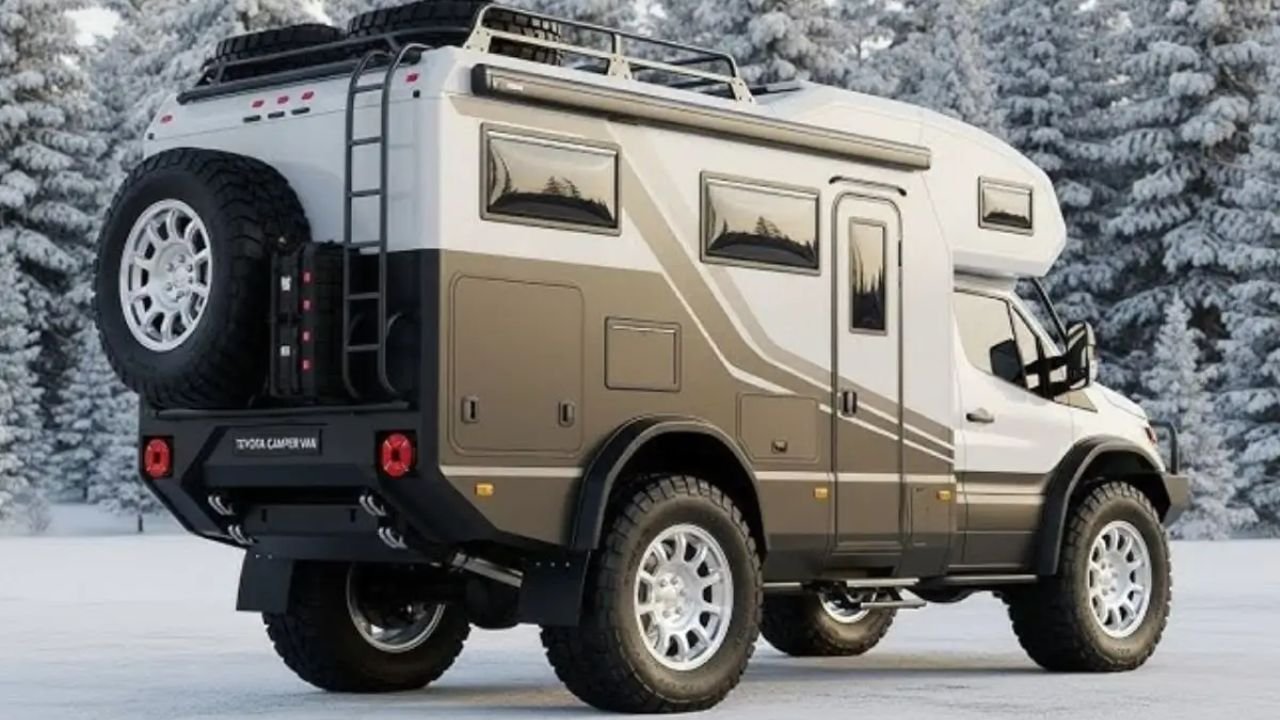
The Toyota HiAce has long been known as a practical van for carrying people, tools and cargo. But its large interior and strong diesel engine also make it an interesting base for a camper van. In 2026, the HiAce continues to offer the kind of space and practicality that can work well for road trips, camping and long-distance travel.
One important point is that Toyota Australia sells the HiAce mainly as a van, crew van and people mover rather than as a factory-built camper van. That means a camper version is generally created through a conversion, using the HiAce as the base vehicle. The good news is that Toyota offers different body lengths, with the Super Long Wheelbase version providing up to 9.3 cubic metres of cargo space.
A Strong Base for a Camper Van
The biggest reason the HiAce works so well as a camper is its size. The standard Long Wheelbase van has around 6.2 cubic metres of cargo space, while the Super Long Wheelbase version increases that to around 9.3 cubic metres.
That gives a camper conversion plenty of room for a bed, storage cabinets, cooking equipment, a small fridge, battery systems and other travel equipment. The larger SLWB model is especially interesting for people who want to spend several days or even weeks on the road without feeling too cramped.
The 2.8-Litre Diesel Engine Does the Heavy Work
The 2026 HiAce range in Australia uses a 2.8-litre turbo-diesel engine. Toyota lists up to 139 kW of power and up to 450 Nm of torque for the relevant automatic diesel van configuration. The van can also be paired with a six-speed automatic or six-speed manual transmission depending on the grade.
For a camper van, the strong torque is useful because a converted vehicle can become much heavier than an empty commercial van. Once you add a bed, water, camping equipment, batteries, food and luggage, having a strong diesel engine becomes important for highway driving and hills.
| Feature | 2026 Toyota HiAce |
|---|---|
| Engine | 2.8-litre turbo diesel |
| Maximum power | 139 kW |
| Maximum torque | Up to 450 Nm |
| Transmission | 6-speed automatic or manual, depending on grade |
| LWB cargo space | Up to 6.2 m³ |
| SLWB cargo space | Up to 9.3 m³ |
| Maximum payload | Up to 1,135 kg |
| Seating range across HiAce models | 2 to 12 |
The Super Long Wheelbase Is the Camper Favourite
If the main goal is to build a proper travel van, the SLWB version deserves serious attention. It is about 5.9 metres long and 2.28 metres high, with around 3.18 metres of internal cargo length and 1.76 metres of internal width.
That extra length makes a big difference when designing the interior. A conversion can potentially have a permanent sleeping area while still leaving room for storage and other camping equipment.
The standard LWB is easier to maneuver and still provides useful space, but the SLWB offers much more freedom for a full camper layout.
A Practical Camper Layout Makes More Sense
A good HiAce camper does not need to be filled with expensive equipment. The smartest layout is usually one that uses the available space carefully.
A simple setup could include a sideways or lengthwise bed, storage underneath, a compact kitchen area and a small electrical system. More advanced conversions can add a portable toilet, indoor shower, larger refrigerator and additional water storage.
The key is to avoid adding too much weight. A camper conversion needs to remain practical, safe and within the vehicle’s payload limits.
Plenty of Space for Sleeping
One of the biggest advantages of converting a HiAce is that you can build the interior around your own sleeping needs.
A simple bed platform can use the space underneath for luggage, camping chairs, cooking equipment and other items. A foldable bed can provide even more flexibility because the area can be changed into a seating or storage space during the day.
The SLWB’s longer body gives converters more choices, especially for people traveling as a couple.
Storage Is One of Its Biggest Strengths
Storage is often one of the hardest things to manage in a small camper. The HiAce has an advantage because it starts with a large commercial cargo area.
Toyota lists overhead storage on the SLWB van, along with a large cargo area. That means a conversion can make use of both the floor and upper sections of the van.
For long trips, this space can be used for clothes, food, tools, camping equipment and other travel items without putting everything on the bed.
The Interior Can Be Customized
Toyota itself offers a range of genuine accessories for the HiAce, including roof racks and other equipment designed around commercial use. A camper conversion can take that basic idea much further.
Owners can create their own interior based on how they travel. Someone who mainly takes weekend trips may want a simple bed and storage system, while a full-time traveler may need a more complete setup with cooking, power and water systems.
This flexibility is one of the biggest advantages of using a commercial van as a camper base.
Modern Technology Is Already Built In
The 2026 HiAce is not an old-fashioned work van when it comes to basic technology. Toyota lists an 8-inch color touchscreen on the current LWB and SLWB van grades, along with wireless Apple CarPlay and Android Auto. Satellite navigation and other connectivity features are also available depending on the grade.
That is useful for a travel van because navigation, music and phone connectivity are important during long road trips.
Safety Is a Major Part of the Package
The HiAce also comes with a range of driver-assistance technology. Depending on the model, the equipment includes Pre-Collision Safety with automatic emergency braking, Lane Departure Alert with Lane Trace Assist, Road Sign Assist, Automatic High Beam and Emergency Driver Support System.
The LWB and SLWB van versions also offer features such as blind-spot monitoring, rear cross-traffic alert, a reversing camera and parking sensors.
For a vehicle that may spend long hours traveling between cities and remote areas, these features can be particularly useful.
Fuel Economy Matters on a Long Road Trip
Fuel consumption is an important part of camper ownership because long road trips can involve thousands of kilometres.
Toyota lists 7.4 litres per 100 km as the combined figure for the LWB turbo-diesel manual configuration in Australia. Actual fuel use can be different in real-world camping conditions because a converted van carries additional weight and may have roof equipment or other modifications.
A fully loaded camper should therefore not be expected to achieve exactly the same consumption as a lightly loaded commercial van.
How Much Can the HiAce Carry?
Payload is another important number for anyone planning a conversion. Toyota lists up to 1,135 kg of payload for the SLWB van and up to 1,115 kg for the LWB automatic van configuration.
That payload has to cover more than just passengers. It also includes the camper conversion itself, water, food, batteries, luggage and other equipment.
This is why a simple, lightweight layout can sometimes be better than installing every possible luxury feature.
Can the HiAce Be Used for Long Trips?
Yes, the basic design makes it well suited to long-distance travel. The semi-bonnet design places the driver behind the engine bay rather than directly over it, which Toyota says helps with cabin quietness, vibration and overall stability.
The van also has a lower and wider front step to make getting into the cabin easier. These small details can become important when the vehicle is being driven for several hours every day.
What About Off-Road Adventures?
The HiAce is better suited to roads, highways, campsites and reasonably accessible travel destinations than serious off-road driving.
It is a large rear-wheel-drive commercial van in the Australian market, and its size can make rough tracks difficult. A camper conversion can also increase weight and reduce ground clearance depending on the equipment fitted.
For people who mainly travel on sealed roads and maintained dirt roads, however, the HiAce can make a practical touring vehicle.
The Biggest Advantages of the 2026 HiAce Camper
A properly planned conversion can turn the HiAce into a comfortable travel vehicle without requiring an enormous motorhome.
- Large interior with up to 9.3 cubic metres of cargo space in the SLWB
- Strong 2.8-litre turbo-diesel engine with up to 450 Nm of torque
- Plenty of room for a bed, storage, kitchen and travel equipment
- Modern safety and connectivity features already included
What Could Be Better?
The HiAce is not perfect for every traveler. Its size can make city parking and narrow roads more difficult, especially with the SLWB body.
The standard vehicle also does not arrive as a complete luxury camper. Buyers who want a refrigerator, cooking area, bed, solar power, water system and bathroom will generally need a conversion or additional equipment.
There is also the issue of weight. A poorly planned conversion can quickly use up the available payload, so every major component needs to be considered carefully.
2026 Toyota HiAce Camper: What Makes It Interesting?
| Area | What the HiAce offers |
|---|---|
| Space | Up to 9.3 m³ in SLWB van |
| Engine | 2.8-litre turbo diesel |
| Power | Up to 139 kW |
| Torque | Up to 450 Nm |
| Technology | Touchscreen, wireless smartphone connectivity |
| Safety | Toyota Safety Sense features |
| Camper layout | Custom conversion |
| Best use | Road trips, camping and touring |
| Main advantage | Large and practical interior |
| Main limitation | Size and conversion weight |
Is the 2026 Toyota HiAce a Good Camper Van?
For the right type of traveler, it can be an excellent base. The HiAce does not try to be a tiny luxury motorhome. Instead, it provides a large, practical space that can be converted according to the owner’s needs.
The SLWB is particularly attractive because its 9.3-cubic-metre cargo area gives converters much more freedom. The LWB is a better option for someone who wants a slightly smaller vehicle while still having enough room for a basic camper setup.
The strongest argument for the HiAce is its combination of space, diesel power, safety equipment and proven commercial-van practicality.
Verdict
The 2026 Toyota HiAce Camper Van is best understood as a highly practical camper base rather than a single factory-built camper model. Toyota’s current Australian range offers LWB and SLWB vans with a 2.8-litre turbo-diesel engine, modern safety technology and plenty of room for a custom travel setup.
For someone who wants to build a travel van for weekend adventures, long road trips or extended touring, the SLWB HiAce stands out because of its large 9.3-cubic-metre cargo area. That space can be turned into a bed, kitchen, storage area and living space with the right conversion.
The most important thing is to keep the layout simple, useful and within the vehicle’s payload limit. With a smart conversion, the HiAce can offer something many travelers want: a practical home on four wheels without the size and complexity of a full motorhome.