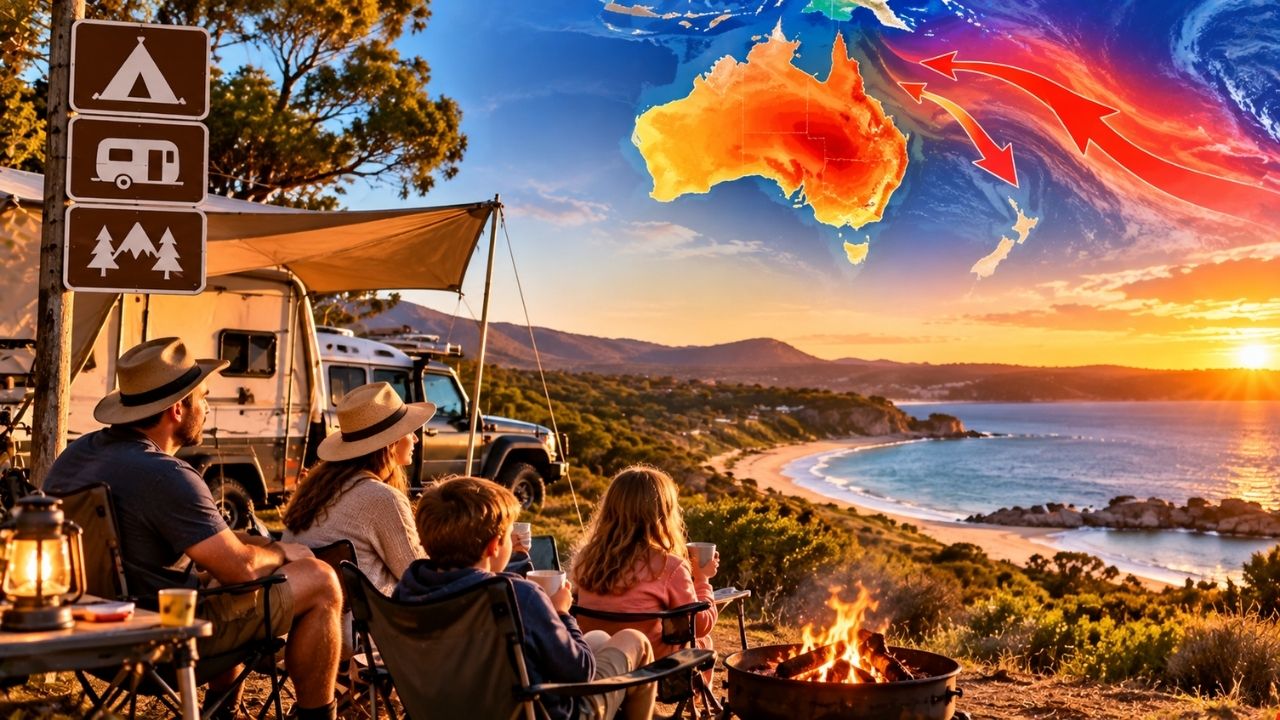
Australia’s spring camping season is arriving with an important weather factor developing across the Pacific: El Niño.
The Bureau of Meteorology says a strong El Niño is now firmly established and is expected to strengthen further during spring, potentially reaching its strongest levels in late spring or summer. At the same time, Australia is facing a warmer-than-average spring in many areas.
For people planning camping, caravanning or weekend trips, that does not mean every destination will be hot and dry. Australia’s weather varies greatly from one region to another. But the developing pattern means checking the forecast closer to departure could become especially important.
What El Niño could mean for spring weather
El Niño is commonly associated with warmer and drier conditions across parts of eastern and southern Australia during winter and spring.
The latest Bureau outlook shows temperatures are likely to be above average across most of Australia during spring. Rainfall is expected to be below average across parts of southern and eastern Australia, while parts of western and central Australia have a higher chance of receiving above-average rainfall.
This regional difference matters for campers.

A campsite that normally has cool spring conditions could experience warmer afternoons, while another location could still receive heavy rain or thunderstorms.
The Bureau also stresses that El Niño is only one influence on Australian weather. Other climate factors, including the Indian Ocean Dipole and unusually warm surrounding waters, can change the final outcome.
Camping could become hotter than expected
For many campers, the biggest difference could be daytime temperatures.
The Bureau says spring 2026 temperatures are very likely to be above average across most of Australia, both during the day and overnight. Warmer conditions increase the possibility of early-season heat, particularly in southern parts of the country.
That can make a major difference when sleeping in a tent, camper trailer or caravan.
A campsite that feels comfortable during a normal spring weekend can become much less pleasant when temperatures remain high after sunset.
Campers may therefore need to think about shade, ventilation, drinking water and the position of their campsite rather than simply choosing a destination based on its usual spring climate.
Rain does not disappear during El Niño
One common misunderstanding is that El Niño means Australia will simply become dry everywhere.
That is not how it works.
The Bureau explains that El Niño can increase the chance of reduced rainfall across parts of Australia, but other weather systems can still produce rain, storms and even periods of heavy rainfall.
The latest October-to-December outlook actually shows above-average rainfall is likely across much of Western Australia and central regions, while below-average rainfall is more likely across parts of the south-east.
For campers, this means a dry seasonal pattern does not remove the need to prepare for sudden weather changes.
A forecast should be checked for the exact location and dates rather than relying only on the national El Niño headline.
Bushfire risk is another reason to plan carefully
Spring is also an important period for bushfire preparation in Australia.
The 2026 Seasonal Bushfire Outlook identified above-average fire potential across parts of northern and south-eastern New South Wales, south-east Queensland, north-eastern Tasmania, Victoria, parts of Western Australia and large areas of the Northern Territory.
That does not mean a bushfire will occur at every campsite in these areas.
Instead, it means weather, vegetation and other conditions may make fires more difficult to manage in some locations.
Campers heading into bush or forest areas should therefore pay attention to local fire danger ratings and warnings. Conditions can change quickly, particularly when hot weather combines with dry vegetation and strong winds.
What campers should check before leaving
A little extra preparation could make spring trips easier.
- Check the latest forecast for the exact camping location shortly before leaving, rather than relying on a forecast made weeks earlier.
- Look at fire danger ratings and any fire or severe-weather warnings affecting the destination.
- Prepare for warmer nights by checking ventilation, shade and drinking-water arrangements.
- Have a backup plan in case extreme heat, fire danger, storms or road conditions make the original campsite unsuitable.
These checks are particularly useful for longer caravan trips, where travellers may pass through several different weather zones.
Spring camping may still be enjoyable
El Niño does not mean Australians should cancel their spring camping plans.
It means the usual assumptions about spring weather may be less reliable.
The Bureau says every El Niño event is different, and the strength of El Niño does not necessarily translate directly into the strength of its effects on Australian rainfall and temperature. Other climate influences also play an important role.
For travellers, the safest approach is to treat the seasonal outlook as a guide rather than a guarantee.
A forecast can change considerably as a camping weekend approaches. Checking the latest information, understanding local fire conditions and being willing to change plans can be more useful than relying on the El Niño label alone.
With temperatures expected to remain above average across much of Australia this spring, campers may simply need to prepare for a warmer season than usual while keeping an eye on changing rainfall and fire conditions.
For anyone planning a spring getaway, the weather could become an important part of the itinerary — not just something to check on the morning of departure.