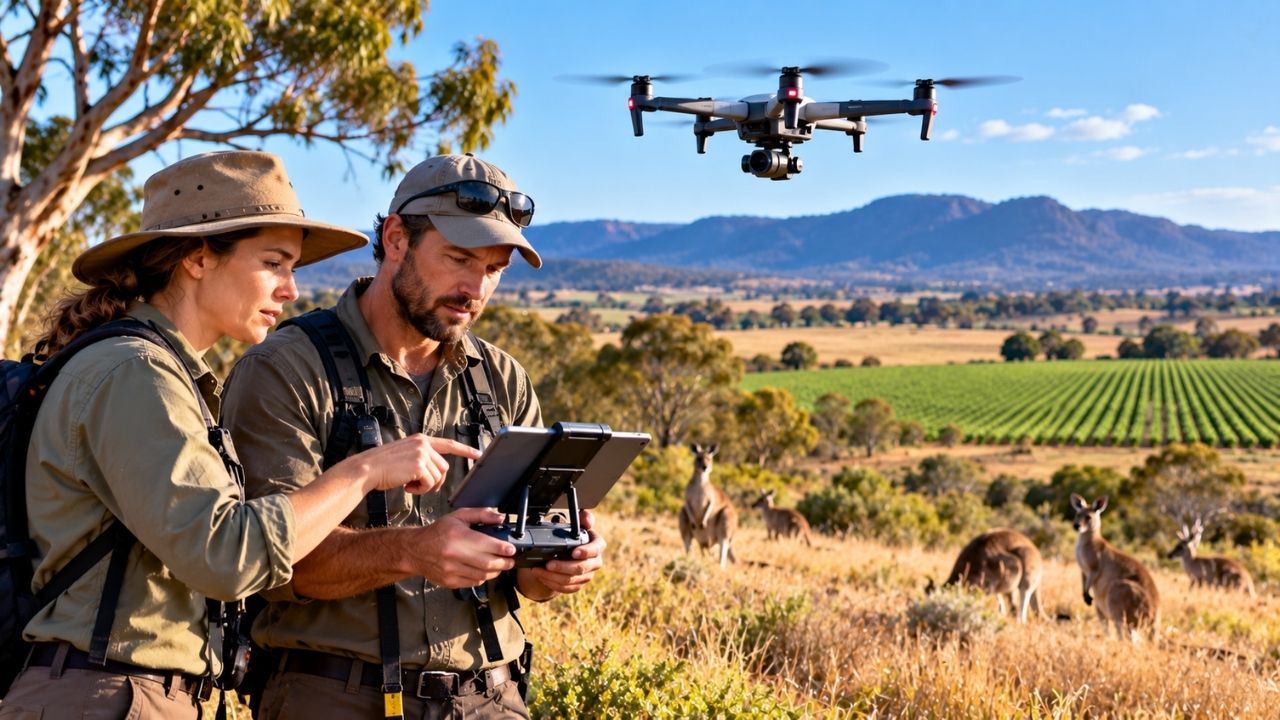
Australian researchers are turning to drones to gather information that was once hard or slow to collect on the ground. These flying tools now help track animals in dense bush and check the health of crops across large paddocks.
Tracking hard-to-find animals from the air
Finding animals like koalas or rare forest mammals can take hours of walking and searching by torchlight. Drones fitted with thermal cameras change that. They fly steady paths over the trees and pick up the heat from animals hiding in the canopy.
Scientists have used this method to detect a range of tree-dwelling mammals, including some that are hard to spot with normal spotlight counts. The flights can cover bigger areas in less time and give repeatable results that can be compared year after year. This helps build clearer pictures of how populations are changing.
Mapping pastures and crops with greater detail
In farming research, drones carry sensors that measure how much grass or crop is growing. One project uses laser scanning to work out the amount of feed available in paddocks. This gives graziers a faster and more accurate idea of what their cattle can eat.
In cotton and other broad-acre crops, drones help with spraying herbicides or pesticides only where needed. They also collect detailed images that show plant stress, growth differences or early signs of problems. Work that once took hours on foot can now cover much larger areas in a single flight.
How drones make fieldwork safer and more efficient
Traditional surveys often mean walking through rough country, climbing steep slopes or spending long days in the sun. Drones reduce some of that risk and effort.
- They reach remote or hard-to-access places without putting people in danger
- They collect data over bigger areas in shorter times
- They allow the same flight path to be repeated for consistent results
- They gather extra information such as height, heat or plant colour in one pass
These advantages mean scientists can focus more time on analysing the information rather than just collecting it.
Supporting pest control and crop health
Drones are also being tested for practical farm tasks. In banana growing areas, researchers have used them to release beneficial mites that help control spider mites. The trials showed the method works well and could become useful for large plantings where ground access is limited.
Weed detection is another growing use. Special cameras and software help map weeds so spray can be applied only where it is needed. This cuts chemical use and saves time on big properties.
What the change means for science and farming
The shift to drones is letting Australian scientists gather richer information at a scale that was not practical before. CSIRO alone now operates a large fleet of drones across many research projects. The technology supports both conservation decisions and day-to-day farm management.
As sensors improve and software becomes easier to use, more teams are likely to adopt these tools. Fieldwork is becoming faster, safer and more detailed, giving researchers and land managers better information to protect wildlife and grow healthier crops.