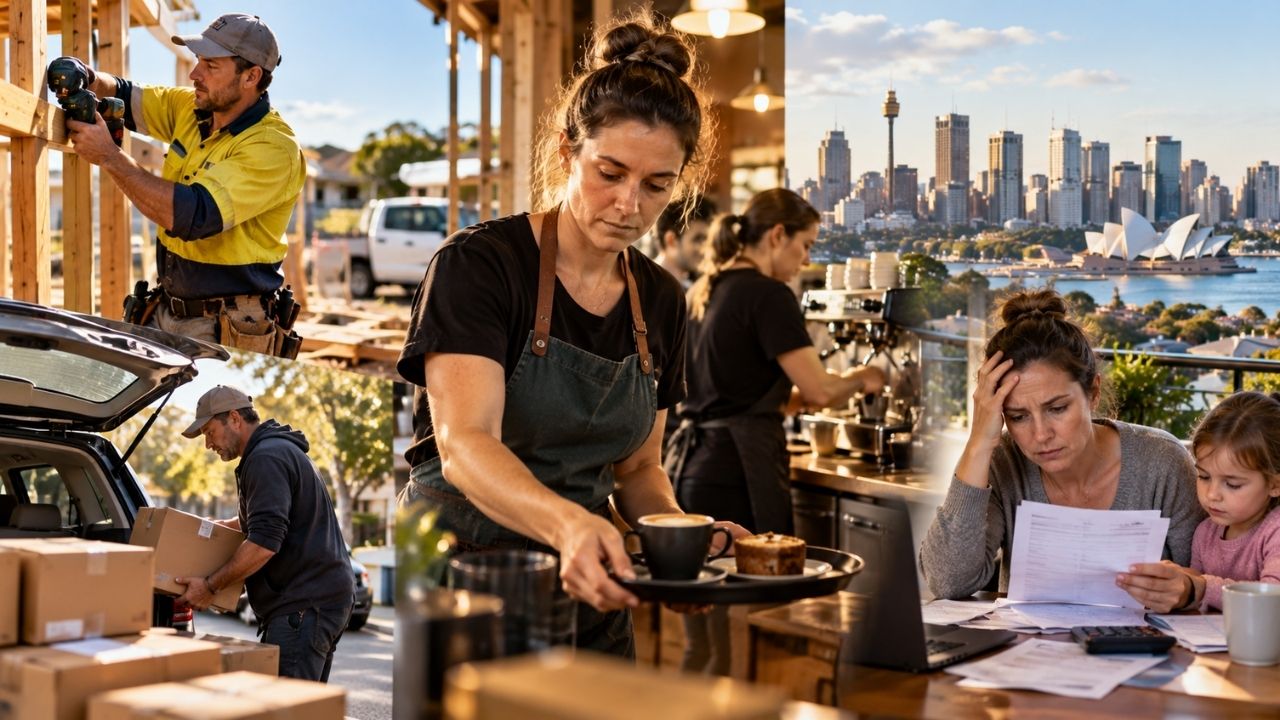
More Australians are working more than one job, with the latest figures showing that about 1 million people were multiple job-holders in June 2026. That means people are working a main job and at least one other job at the same time.
The rise comes as households continue to manage major everyday costs. While working a second job can have different reasons, the latest data shows that having another source of income has become a common part of working life for a growing number of Australians.
About 1 million Australians now have more than one job
The latest figures show that 1.0 million Australians were working more than one job in June 2026. They represented 6.9% of employed people, which was the highest rate recorded in the available series. The number of multiple job-holders was up 6.6% from March 2026.
The increase is also visible in the number of secondary jobs. There were about 1.16 million secondary jobs in the June quarter, up 4.6% over the quarter and 11.7% over the year.
| Measure | June 2026 |
|---|---|
| Multiple job-holders | 1.0 million |
| Share of employed people | 6.9% |
| Secondary jobs | 1.16 million |
| Change in multiple job-holders from March 2026 | 6.6% increase |
| Annual change in secondary jobs | 11.7% increase |
These numbers do not mean that every person taking a second job is doing so because of living costs. People can have several jobs for many reasons, including wanting extra income, having limited hours in their main job or taking seasonal work.
Why a second job can help a household budget
For some workers, the main job does not provide enough income for the number of hours they want to work. A second job can provide another source of money without requiring the person to leave their main employment.
The Australian Bureau of Statistics explains that some multiple job-holders face a wage limit in their main job, while others have an hours limit. For example, a person may have a regular weekday job but take another job on weekends because extra hours are available there.
This can make a difference when a household has several regular bills to manage.
Rent or mortgage payments, food, electricity, transport, insurance and other household costs can take up a large part of monthly income. An additional job can give a worker more money to put toward these expenses or leave a little more room in the household budget.
The extra work is not always a small commitment
Working two jobs can mean adding a significant number of hours to the working week.
Earlier 2026 data showed that multiple job-holders worked an average of 30 hours a week in their main job and another 9.3 hours in their secondary jobs. Together, that was an average of 39.3 hours a week.
This average does not describe every worker. Some people may work only a few extra hours, while others may have much longer working weeks.
The extra hours can also affect how much time people have for family, rest and other parts of everyday life. For households already under financial pressure, the choice can therefore involve more than simply deciding whether another job is available.
Women and younger workers are more likely to have multiple jobs
The latest figures show differences between age groups and between men and women.
In June 2026, 7.7% of employed women were multiple job-holders, compared with 6.2% of employed men. Workers aged 20 to 24 had the highest multiple job-holding rate at 11.2%.
The pattern also varies by industry. Administrative and support services had the highest multiple job-holding rate among industries listed in the June 2026 data, at 9.8%.
Some of the reasons for having more than one job are linked to the type of work itself. Seasonal work and jobs where hours change from week to week can make it easier or more necessary for workers to have another source of employment.
The trend is not simply about people wanting to work more
It would be too simple to say that everyone taking a second job is doing so because prices are higher.
People have different household situations and different reasons for working more than one job. Some may want additional spending money, while others may need extra income to cover regular expenses. Some may have a second job because their main employer cannot provide enough hours.
The ABS data specifically notes that multiple job-holders can have both wage and hours constraints in their main jobs.
This distinction is important because the headline number shows how many people have multiple jobs, but it does not tell us the personal reason behind every individual decision.
What the change means for household finances
For a household, a second income stream can provide useful breathing room. Even a part-time second job can help with bills when the main income is not keeping up with household needs.
But earning more also means giving more time to work. Transport costs, childcare and other expenses linked to the second job can also affect how much extra money actually remains in the household budget.
The financial effect therefore depends on the worker’s pay, hours, travel costs, tax situation and household expenses.
A growing part of Australia’s working life
The latest figures show that multiple job-holding is no longer a small part of the Australian labour market. Around 1 million employed people were working more than one job in June 2026, and the number of secondary jobs increased strongly over the year.
For some Australians, a second job is a way to earn extra money and manage household expenses. For others, it reflects limited hours in their main job or the nature of their industry.
Either way, the increase gives a clear picture of how some workers are responding to the pressures and opportunities in today’s labour market. For households, the extra income can help the budget, but it can also come with the cost of more working hours and less free time.