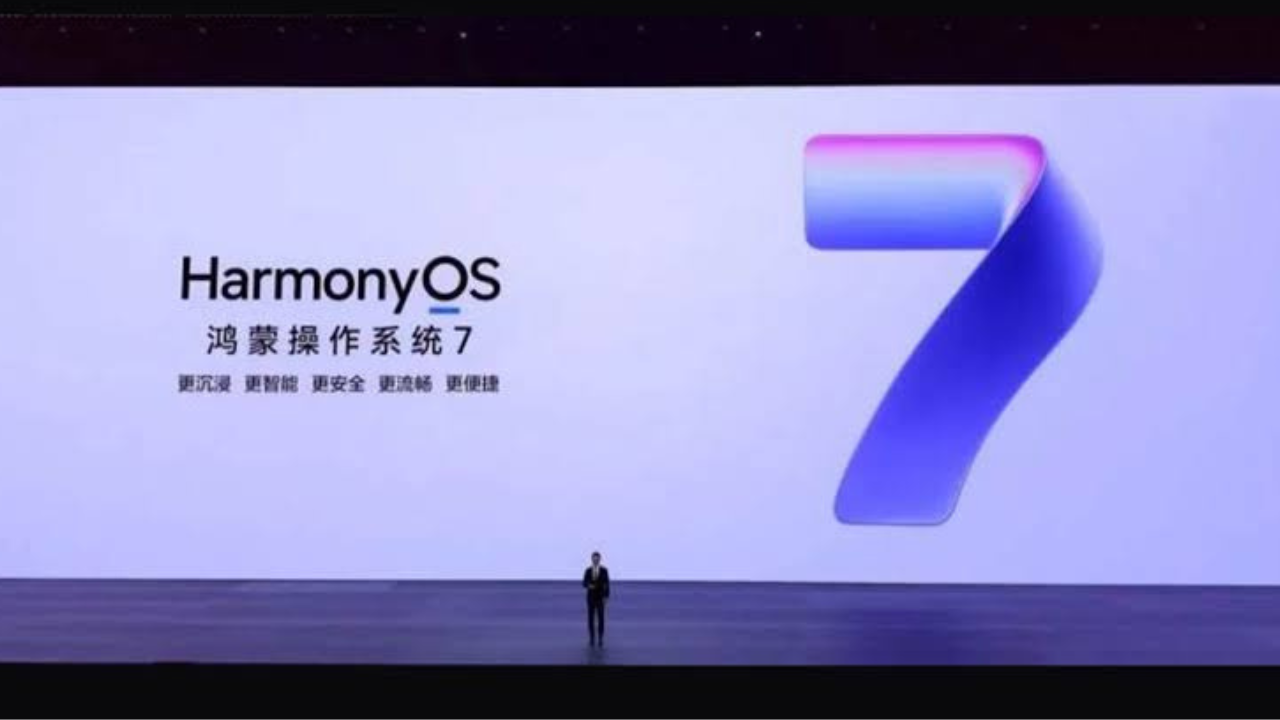
Huawei has officially launched HarmonyOS 7, bringing one of the biggest changes to its operating system in recent years. The new version puts AI much deeper into the system, adds stronger protection against scams, and introduces a fresh design built around what Huawei calls a spatial visual experience.
The public beta began on September 7, 2026, for the first supported devices in mainland China. Huawei says the new system is designed to be smarter, safer, smoother, and more closely connected across devices.
HarmonyOS 7 gets a completely refreshed look
The new design is one of the first changes users are likely to notice. Huawei has introduced a new spatial design style that gives the system more depth and movement instead of relying mainly on flat menus and icons.
The lock screen now supports 3D spatial wallpapers and a spatial clock. Photos can be used with the clock to create a stronger sense of depth, making parts of the image appear to sit around the clock rather than simply behind it.
Huawei has also brought glass-like visual effects to areas such as the notification center and folders. Animations and lighting effects respond to actions such as moving icons or interacting with notifications, making the interface feel more active.
This does not mean that every part of the phone has been completely redesigned. Instead, Huawei is applying the new design language across more parts of the system so that the experience feels more consistent.
Celia becomes a much smarter AI assistant
AI is arguably the biggest change in HarmonyOS 7. Huawei’s AI assistant, known as Xiaoyi in China and Celia in some international markets, is being moved deeper into the operating system.
Rather than acting mainly as a tool that answers questions or follows simple voice commands, the upgraded assistant is designed to understand a user’s intention and use system and app functions to complete tasks.
Huawei describes Xiaoyi as a system-level intelligent agent. The company says it can use more than 200 types of system-level information and an always-on sensing system to improve its understanding of context, while stronger memory and context handling are intended to make the assistant more useful over time.
Huawei has also upgraded its Agent Framework to version 2.0. The company says the framework supports more than 20 system-level AI capabilities and allows developers to build services that can be reached through system-level AI functions.
For everyday users, the main idea is simple: instead of opening several apps and completing every step manually, the AI assistant can increasingly act as a bridge between the user, apps, services, and the operating system.

AI security is another major part of the update
Huawei is giving HarmonyOS 7 a much stronger focus on scam protection. The new security system, called HarmonyOS Xingdun Security in China, uses AI and device-level security features to identify several types of suspicious activity.
The system can detect potential fake voices during calls, identify suspicious overseas call routing, check risky web content, and recognize potentially dangerous QR codes. Huawei has also introduced protection against certain scam patterns that involve several steps rather than one clearly dangerous action.
The idea is to warn users while a suspicious activity is happening instead of waiting until after money or personal information has already been lost.
Some of the main security improvements include:
- AI detection for possible fake or changed voices during calls
- Detection of suspicious overseas call routing and disguised numbers
- AI checks for risky web pages and QR codes
- Protection against more complex scam patterns involving several apps or actions
Huawei says the upgraded security system has also received a high-level certification for its ability to help prevent and control telecom and online fraud.
HarmonyOS 7 also focuses on speed and battery life
The update is not limited to AI and design. Huawei has also upgraded its Ark Engine, which manages important parts of system performance.

The new version uses a performance model that considers factors such as usage habits, app relationships, time, location, and app importance when deciding where to focus system resources. Huawei says this is intended to keep commonly used apps running smoothly while making better use of the phone’s hardware.
Huawei has also announced a new spatial memory technology. According to the company, supported devices can gain up to 3GB of usable memory through the new system’s memory management improvements. Huawei also says some supported phones can recover a significant amount of storage after moving from HarmonyOS 6 to HarmonyOS 7, although the exact amount depends on the device and storage configuration.
These claims are device-dependent, so users should not expect the same performance or storage improvement on every Huawei phone.
HarmonyOS 7 rollout and supported devices
HarmonyOS 7 began its first public beta rollout on September 7, 2026. Huawei’s official information says the first group is limited to selected devices sold in mainland China.
Huawei has listed more than 50 devices entering the public beta program, while additional phones, tablets, watches, and audio products are scheduled for later testing stages. The company has also said that HarmonyOS 7 is currently available for upgrade only in mainland China and that it has not yet announced an overseas rollout plan.
| Update detail | HarmonyOS 7 |
|---|---|
| Official launch | September 7, 2026 |
| First public beta | September 7, 2026 |
| First rollout area | Mainland China |
| Main focus | AI, security, design, performance and device connection |
| AI assistant | Xiaoyi in China, known as Celia in some international markets |
| Current overseas availability | No HarmonyOS 7 upgrade announced yet |
| Upgrade process in China | Through the My HUAWEI app for supported devices |
Huawei says users with devices included in the first public beta can check the My HUAWEI app and use the upgrade trial section to see the available update.

What HarmonyOS 7 means for Huawei users
The biggest change in HarmonyOS 7 is not one individual feature. It is the way Huawei is connecting AI, the operating system, apps, security, and different devices.
Celia is being turned into a deeper system-level assistant instead of remaining mainly a voice tool. Security features are using AI to look for scams and suspicious activity. At the same time, the new interface gives the operating system a noticeably different visual style.
Huawei is also continuing to build its own app and service ecosystem around HarmonyOS. The company says more than 40,000 applications and services were available in its ecosystem as of September 7, 2026, covering areas such as daily services, travel, finance, social services, productivity, entertainment, and government services.
For people already using compatible Huawei devices in China, HarmonyOS 7 is therefore more than a normal software update. It is a broader move toward an operating system where AI can understand what the user wants and help complete tasks across different parts of the device.
Final thoughts
HarmonyOS 7 brings together three major changes: a fresh new interface, a much more capable AI assistant, and stronger AI-based security.
The new spatial design gives the system a more modern look, while the upgraded Celia or Xiaoyi experience aims to make AI useful for real tasks rather than simple questions. At the same time, the new security tools are designed to catch scams, suspicious calls, dangerous web pages, and other risks earlier.

The rollout is still in its early stage. For now, the official upgrade is limited to supported devices sold in mainland China, while Huawei has not announced an overseas HarmonyOS 7 upgrade plan. As more compatible devices receive the software, the real test will be how well these new AI and security features work in everyday use.