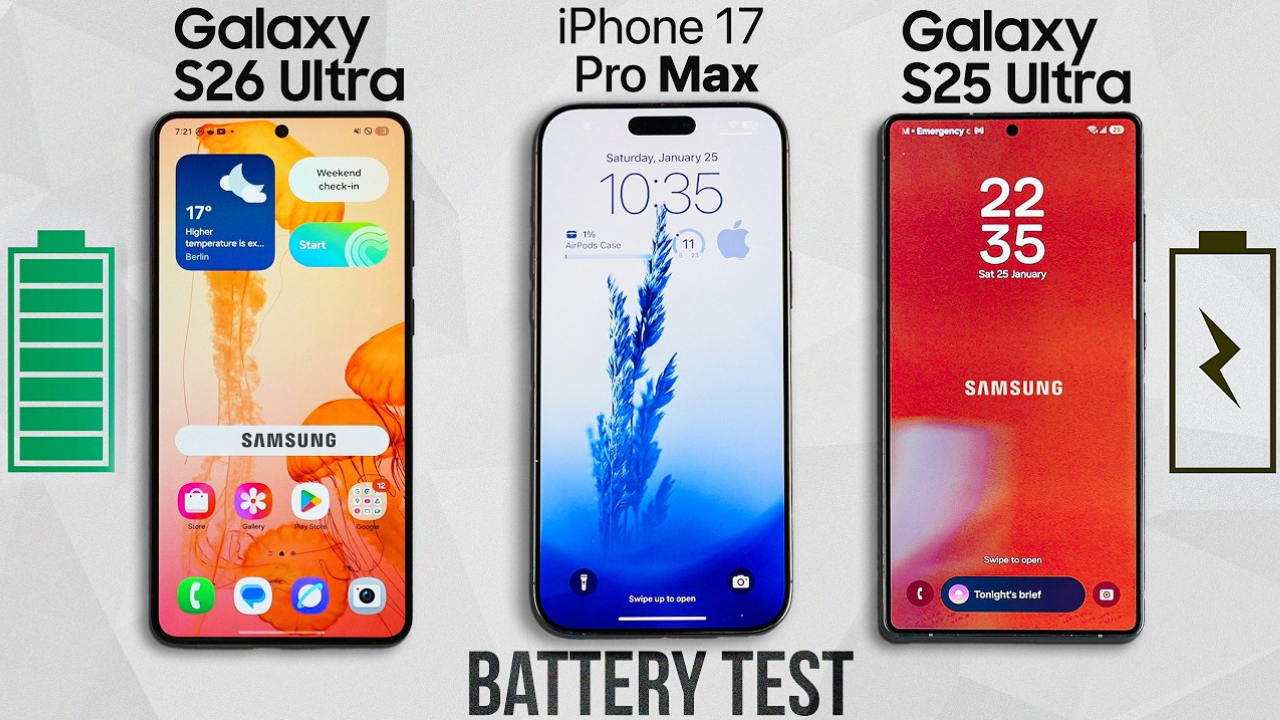
The Galaxy S26 Ultra has a 5,000mAh battery, but that number looks surprisingly small next to the battery inside the POCO X8. Xiaomi’s new phone packs an 8,340mAh silicon-carbon battery, creating a difference of 3,340mAh between the two devices.
That does not automatically mean the POCO X8 will last longer in every situation. Battery life depends on the processor, display, software, network connection and how a phone is used. Still, the size difference is hard to ignore.
The battery capacity gap is very large
Samsung lists a typical battery capacity of 5,000mAh for the Galaxy S26 Ultra. The phone has a rated capacity of 4,855mAh and supports up to 60W wired charging.
The POCO X8 goes much further. Xiaomi lists an 8,340mAh typical-capacity battery, along with 67W HyperCharge. It uses silicon-carbon battery technology and supports up to 22.5W wired reverse charging.
That means the POCO X8 has about 66.8% more battery capacity than the Galaxy S26 Ultra when comparing their typical capacities.
| Battery detail | Galaxy S26 Ultra | POCO X8 |
|---|---|---|
| Typical battery capacity | 5,000mAh | 8,340mAh |
| Difference | – | 3,340mAh more |
| Charging | Up to 60W wired | 67W HyperCharge |
| Battery type | Lithium-based | Silicon-carbon |
| Reverse charging | Wireless PowerShare | Up to 22.5W wired |
Why the POCO X8 can fit such a large battery
The POCO X8 is built differently from Samsung’s flagship.
Its 8,340mAh battery is a major part of the phone’s design. Xiaomi uses silicon-carbon battery technology, which allows manufacturers to put a large amount of battery capacity into a relatively compact battery pack.

The phone has a 6.83-inch 1.5K AMOLED display and weighs 223 grams. Its body is 8.6mm thick.
That size and weight give POCO more room to prioritize battery capacity.
The Galaxy S26 Ultra takes a different approach. Samsung’s flagship is 7.3mm thick and weighs 214 grams, while offering a 6.9-inch display.
So the battery comparison also highlights a design trade-off. POCO puts more emphasis on battery capacity, while Samsung keeps its flagship considerably slimmer while still offering a 5,000mAh battery.
Samsung’s smaller battery does not mean poor battery life
It would be wrong to look at the numbers and conclude that the Galaxy S26 Ultra has weak battery life.
Samsung says the S26 Ultra can provide up to 31 hours of video playback under its testing conditions. That is an important figure because actual battery life depends on many factors and cannot be predicted from battery capacity alone.
A phone with a smaller battery can sometimes last longer than a phone with a much larger battery if it has more efficient hardware and software.

The processor, screen brightness, refresh rate, cellular signal, apps running in the background and camera use can all affect how quickly a battery drains.
POCO’s huge battery changes the equation
The POCO X8 still has an obvious advantage in raw battery capacity.
An 8,340mAh battery gives the phone a much larger energy reserve than the 5,000mAh unit in the Galaxy S26 Ultra. Xiaomi itself advertises the X8 as offering more than two days of battery life under its stated testing conditions.
This could be particularly useful for people who spend many hours away from a charger.
The difference may be noticeable during heavy use such as gaming, video streaming, navigation and mobile data use. However, the exact difference in screen-on time will vary depending on how each phone is configured and used.
Charging is also slightly faster on the POCO
The POCO X8 supports 67W HyperCharge, while the Galaxy S26 Ultra supports up to 60W wired charging.
The difference in charging power is not nearly as dramatic as the difference in battery capacity.

In fact, charging speed should not be judged only by the wattage printed on the specifications sheet. Charging behavior changes as the battery fills, and factors such as temperature and battery condition can affect the actual result.
Still, POCO has combined a very large battery with faster rated wired charging, which makes the X8 particularly interesting for users who want both capacity and quick charging.
The two phones are designed for different buyers
The battery comparison also shows why these phones should not be judged only by one specification.
The Galaxy S26 Ultra is Samsung’s premium flagship. It combines a 6.9-inch display, a 200MP main camera, advanced camera hardware, Galaxy AI features and a much slimmer body.
The POCO X8 takes a different path. It offers a large 6.83-inch AMOLED display, Snapdragon 6s Gen 4 hardware, an 8,340mAh battery and 67W charging.
In simple terms, the POCO X8 puts much more emphasis on battery capacity, while the Galaxy S26 Ultra aims to provide a wider premium experience.
What the huge battery difference means in real life
For someone who mainly uses a phone for calls, messaging, social media and occasional video, the enormous battery difference may not be necessary.

But heavy users can benefit more from a large battery. People who spend long periods gaming, watching videos, using mobile data or traveling may appreciate having more capacity available.
The POCO X8 also supports wired reverse charging, so its large battery can be used to provide power to compatible devices.
The Galaxy S26 Ultra, meanwhile, supports Wireless PowerShare, allowing compatible devices to be charged wirelessly from the phone.
These are two different approaches to sharing battery power.
The key numbers at a glance
- Galaxy S26 Ultra: 5,000mAh typical battery
- POCO X8: 8,340mAh typical battery
- POCO X8 has 3,340mAh more capacity
- POCO X8 supports 67W charging, compared with up to 60W wired charging on the S26 Ultra
The raw numbers clearly favor the POCO X8. But battery capacity alone cannot tell you exactly how many hours either phone will last.
Final thoughts
The Galaxy S26 Ultra versus POCO X8 battery comparison is a perfect example of why smartphone specifications can be surprising.
Samsung’s flagship has a 5,000mAh battery, which is enough for up to 31 hours of video playback under Samsung’s stated test conditions. The POCO X8, meanwhile, carries an enormous 8,340mAh battery and supports 67W HyperCharge.

The POCO therefore has a huge advantage in raw battery capacity. But the Galaxy S26 Ultra is considerably thinner and lighter while packing a flagship camera system, a high-end display and powerful hardware.
If your main priority is having the biggest possible battery, the POCO X8 is the clear standout. If you want a premium all-round smartphone and are satisfied with a 5,000mAh battery, the Galaxy S26 Ultra takes a much broader approach.
The biggest lesson is simple: more mAh does not automatically mean longer battery life, but an extra 3,340mAh gives the POCO X8 a very large advantage on paper.